Black Friday came early. Early-access prices until Nov 8.Black Friday: early-access prices until Nov 8.Early-access price ends in0d00h00m00sClaim the deal



When you’re optimizing your ad campaigns, every minute counts. If you rely on delayed cost data, you might be losing money on inaccurate optimization strategies. That’s exactly why real-time cost tracking has become a must-have for media buyers advertising on platforms like Meta, TikTok, Google, or native sources.
With ClickFlare’s new 5-minute cost update, you finally get cost data that is fully accurate. In this article, we’ll explain how media buyers are cutting their ad spend and scaling their campaigns with real-time cost tracking.
Media buyers have to often make fast decisions to pause or scale campaigns based on metrics such as ROAS or CPA. When calculating these metrics, even a 30-minute delay can lead to inaccurate decisions.
Recently, we noticed a recurring pattern among high-volume media buyers: estimation-based cost data simply wasn’t enough during fast traffic changes.
This makes sense when you look at how fast today’s ad platforms are moving. Meta’s algorithm shifts budgets automatically throughout the day, TikTok traffic can suddenly increase without warning, and lead gen or pay-per-call traffic can jump 10x within minutes. CPCs also tend to fluctuate depending on competition or time of day, and bidding algorithms can speed up your spending quickly.
If your cost data is not properly updated during these moments, you may end up overspending or making uninformed decisions. This is where real-time cost tracking becomes very important.
ClickFlare pulls cost data directly from each ad platform at set intervals: every 1 hour on Starter and Pro plans, and every 30 minutes on Master and above. Between those updates, ClickFlare estimates your spend using a simple formula:
Last Known CPC × Number of Visits/Clicks
Under normal conditions, this estimation is reasonably accurate. But when traffic starts moving quickly, everything changes. During sudden spikes or changes, the estimator continues using old CPC data, while your actual CPC may have already shifted dramatically.
This usually happens during moments like:
For example, imagine launching a new Meta campaign that gets an immediate burst of traffic. Your real CPC adjusts almost instantly, but the estimator still relies on outdated numbers. As a result, your reported cost can be inaccurate for 30-60 minutes.
These delays can negatively affect your performance, because under these conditions:
High-volume media buyers consistently told us that when traffic moves fast, real-time cost tracking becomes a must.
One of the key benefits of real-time cost tracking is the ability to work with data that clearly reflects what’s happening right now. This allows you to optimize efficiently even when traffic patterns become unpredictable.
When your cost updates keep up with Meta’s delivery shifts, TikTok surges, or arbitrage spikes, you can make decisions at the exact moment they matter. You immediately know which campaigns are staying profitable, which ones are failing, and where your budgets need to be adjusted.
Real-time cost tracking also improves overall accuracy. With precise cost data feeding into your ROAS, CPA, and automation rules, your optimizations become more reliable. Instead of optimizing with inaccurate numbers or waiting for the next sync to confirm your decisions, you can move quickly without taking on unnecessary risk.
Ultimately, real-time cost tracking helps media buyers cut ad spend and scale faster.
To solve the challenges our high-volume media buyers were facing during these fast-moving traffic moments, we built ClickFlare’s 5-minute cost update. Instead of waiting 30 to 60 minutes for the next data sync, your cost data now refreshes every five minutes, giving you visibility that’s as close to real-time as possible.
With this update, you will get reliable campaign performance data, especially during those moments where each minute counts. Whether you’re launching a new ad, optimizing existing campaigns, or creating automation rules, your decisions will now be based on real-time cost data rather than outdated estimates.
With 5-minute updates, you unlock:
Alongside the 5-minute cost update, we also recently introduced Cost Logs, a way for you to see with full transparency how and when your cost data syncs. Instead of guessing when the latest update happened, you can now see a full timeline and are able to track each sync event.
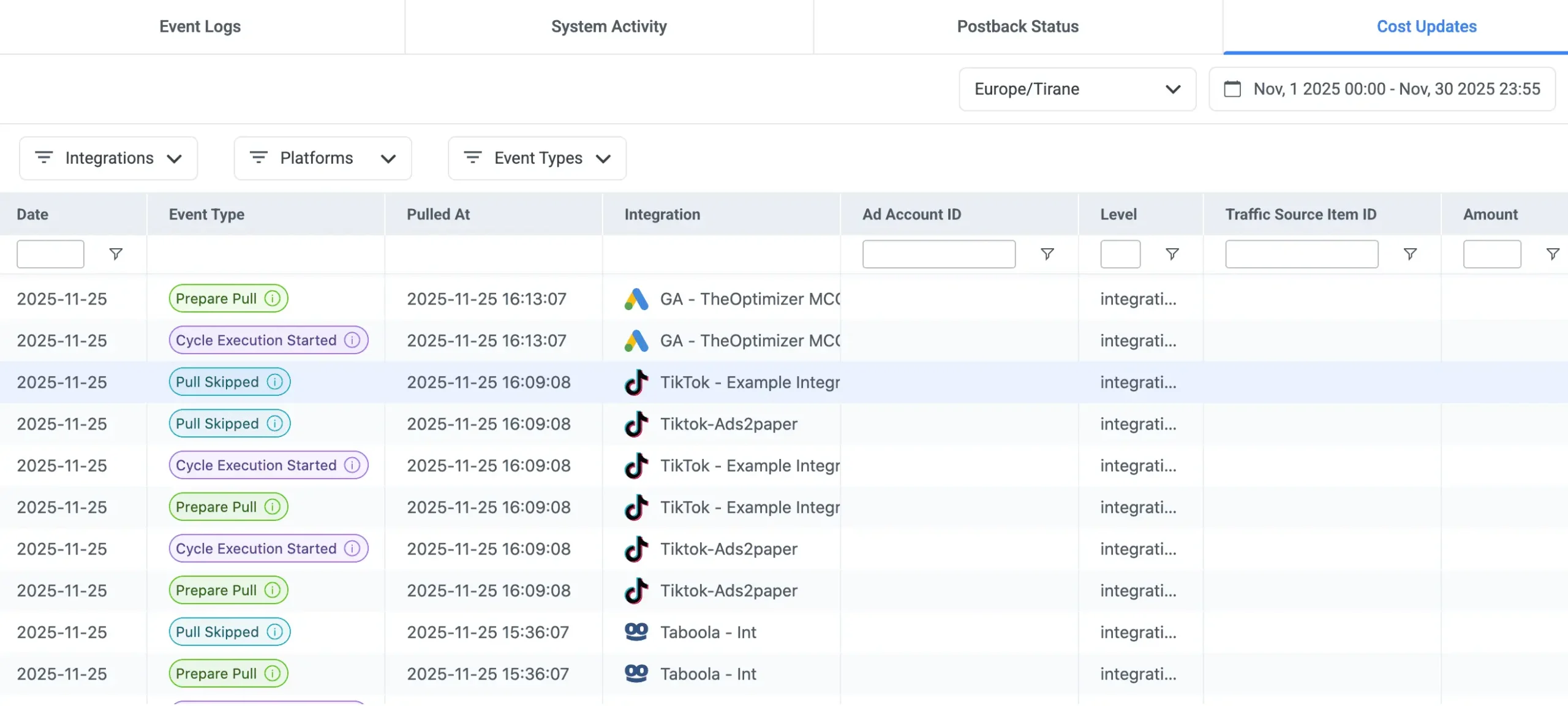
With Cost Logs, you can see:
We created this feature to give you more clarity and confidence in the numbers you’re optimizing with. Along with real-time cost tracking, our clients are able to use Cost Logs to make smarter decisions regarding campaign optimization.
This case study comes from one of our high-volume ClickFlare clients who manages fast-moving Meta campaigns on a daily basis.
They were testing a new campaign with multiple creatives on Meta, with the goal of scaling quickly if early performance looked promising. Within minutes of launching, traffic started coming in. CPC shifted as Meta’s delivery algorithm explored new audiences, and the campaign began spending much faster than expected.
Before using the 5-minute cost update, this kind of situation was much harder for them to manage. ClickFlare’s cost estimation would still be relying on the previous CPC, even though the real CPC had already changed. For the next 30-60 minutes, reported costs lagged behind, which meant their ROAS and CPA appeared stable when that was not the case. During these early, high-speed moments, they avoided scaling or pausing campaigns because they weren’t fully confident the numbers were accurate yet. And by the time the next cost sync arrived, part of the testing budget was already wasted.
With the 5-minute cost update, their experience was completely different. Cost data refreshed within minutes, so the CPC shift showed up almost immediately.
One of our clients even said, "My cost in ClickFlare updates even faster than in Facebook".
With this update, ROAS and CPA also updated in real time, which made it clear which creatives were gaining traction and which ones needed to be paused. Instead of waiting for the next sync, they immediately took action and adjusted their creatives as well as their budget to scale without losing momentum.
Since testing the new 5-minute cost update, this client has already cut wasted ad spend by around 7% simply by reacting faster to early performance indicators.
Real-time cost tracking isn’t only useful during traffic spikes, but it’s also very beneficial for any media buyer working with fast-moving, unpredictable traffic.
Media buyers working with high traffic volumes can benefit from this update. A small discrepancy may not cause major issues for those running low volumes, but with high volumes even a minor shift can lead to faulty performance optimizations.
Performance marketers who buy traffic from volatile social ad platforms like Meta or TikTok also need this update. As mentioned before, Meta’s algorithm tends to test new audiences and adjust budgets at the beginning, which makes it crucial to have real-time numbers. With TikTok, traffic can spike or drop very quickly, and the hourly update is not as sensitive to these changes.
Certain verticals could also benefit from real-time cost tracking. For example, RSOC and search arbitrage media buyers usually work with high volumes and small margins, so even small cost delays can lead to wasted ad spend.
Lead gen and pay-per-call marketers also need to see how quickly their costs rise relative to lead quality.
E-commerce marketers who are scaling aggressively also gain from real-time visibility when CPC and conversion behavior shift throughout the day.
In short, anyone who is dealing with unpredictable traffic or high volumes that require data precision can greatly benefit from real-time cost tracking.
Fast-moving campaigns demand fast, accurate cost data. When CPC shifts, traffic surges, or algorithms redistribute spend, even a short delay can lead to inaccurate optimization strategies.
With ClickFlare’s 5-minute cost update and full Cost Logs, media buyers finally get the clarity they need to optimize confidently in real time. Whether you’re scaling aggressively or protecting your budget, real-time cost tracking can greatly improve your performance and decision-making.
The faster cost updates have been introduced as add-ons, and the pricing differs based on your monthly ad spend. If you are a Master (or above) user, you will automatically benefit from 30 minute cost updates for free.
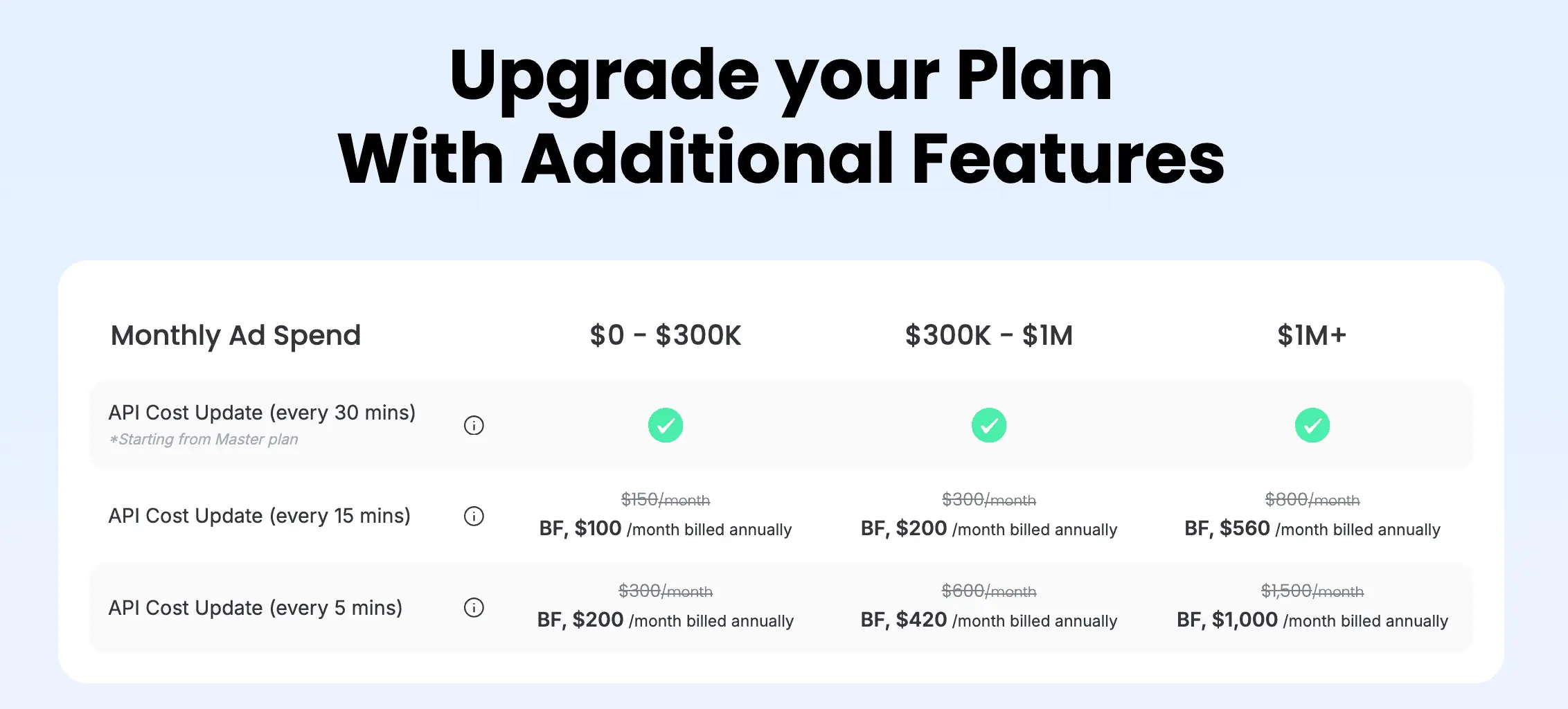
For the 5-minute cost update, the pricing has three different tiers: