


Conversion value tracking has become an important part of performance marketing. Ad platforms optimize campaigns based on the value of conversions, not just the volume.
If the values sent to your ad platform are inaccurate, your campaigns are optimizing using the wrong signals. This makes controlling conversion values before they are sent to ad platforms essential.
In this article, we’ll look at how revshare, payout caps, and tiered payouts can improve the accuracy of conversion value tracking.
Conversion value tracking is the process of sending the monetary value of a conversion along with the conversion event. Instead of only reporting the number of conversions, your tracker can also pass the value of that conversion (e.g., revenue, commission, or payout).
Performance marketers usually send these values from their ad trackers to ad platforms such as Meta, TikTok, Google Ads, or native platforms such as NewsBreak, Taboola or Outbrain through postbacks, APIs, or webhooks. Ad platforms then use this information to pinpoint which users and campaigns generate the most valuable conversions.
Most trackers only allow you to send raw payouts to ad networks. However, in various scenarios, it might be more beneficial to send an adjusted payout instead of the raw value.
For example, you may only keep a percentage of the revenue due to a revshare agreement, or you may want to cap or modify the value to keep optimization signals consistent.
This is where controlling the values you send out becomes important.
Most ad platforms in recent years do not optimize performance only based on the number of conversions, but also on conversion value.
Ad platforms like Facebook, TikTok and Google Ads use these conversion value signals to decide which users to show your ads to and which campaigns deserve more budget. Meta’s value optimization is designed to show ads to people most likely to generate higher value, while Google’s Maximize Conversion Value and target ROAS bidding use conversion values to set bids and maximize return.
Most marketers use ad trackers to track and report back accurate conversion values to their traffic source. Through this process, the traffic source algorithm learns which traffic is profitable and scales it.
But if the values being sent are incorrect, the optimization process can break. For example, you receive a $100 payout from an affiliate network but only keep 70% due to a revenue share agreement.
If your tracker sends the full $100 value to your traffic source, the ad platform assumes that conversion is worth more than it actually is.
Over time, sending these types of wrong signals to your ad platform leads to inefficient optimization. This is why controlling the values you send from your tracker is crucial.
By adjusting payouts before they are passed to ad platforms, you ensure that the data used for optimization reflects the true value of each conversion.
Smart Payout Control is a more flexible way to handle conversion value tracking by allowing you to adjust values directly inside your tracker before they are sent to traffic sources. Instead of using external scripts or spreadsheets, you can apply logic such as revenue share, caps, or tiered payouts directly within your tracker.
This means the values leaving your tracker already reflect the logic you want, without complicating your setup with additional layers.
By applying adjustments at the source, Smart Payout Control ensures that your conversion value tracking remains accurate and consistent.
It also simplifies your setup, eliminating the need for custom scripts or manual workarounds.
You can apply Smart Payout Control across different levels of your tracking setup.
You can apply it to your conversion API integrations to send adjusted conversion values directly back to platforms like Facebook, Google Ads, TikTok, Snapchat and more via API.
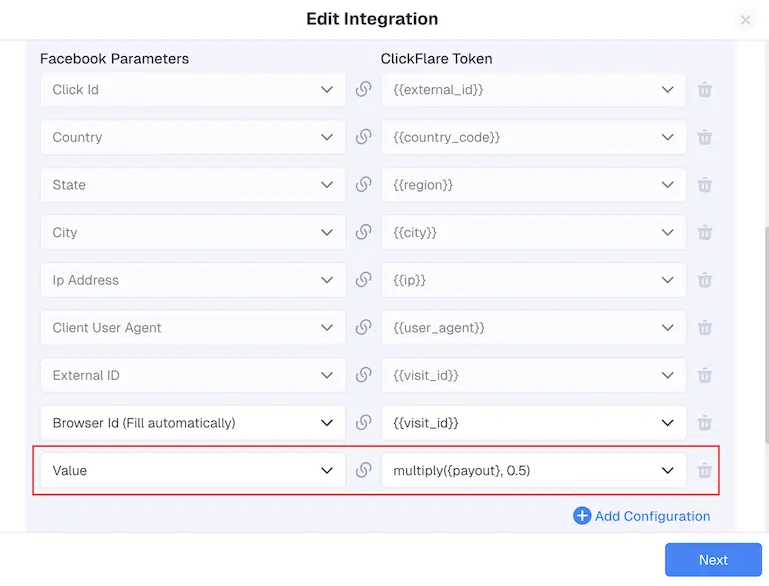
You can also apply it to traffic source postbacks for platforms that support them, such as Taboola, NewsBreak or Outbrain.

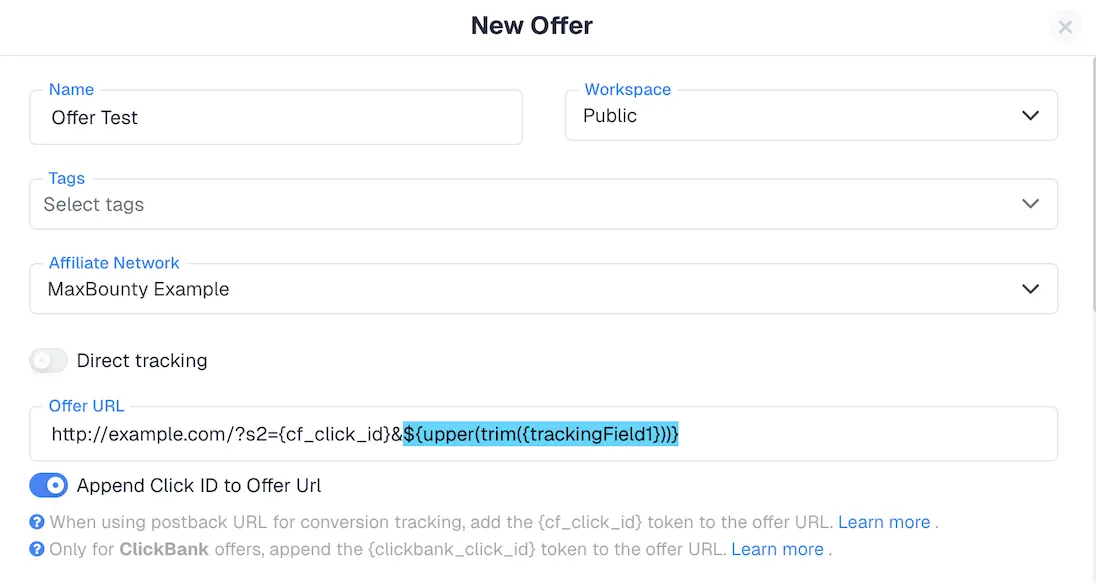
Smart Payout Control can also be used in offer and lander URLs, which is useful when modifying macros, values and parameters through redirects or between different parts of your funnel.
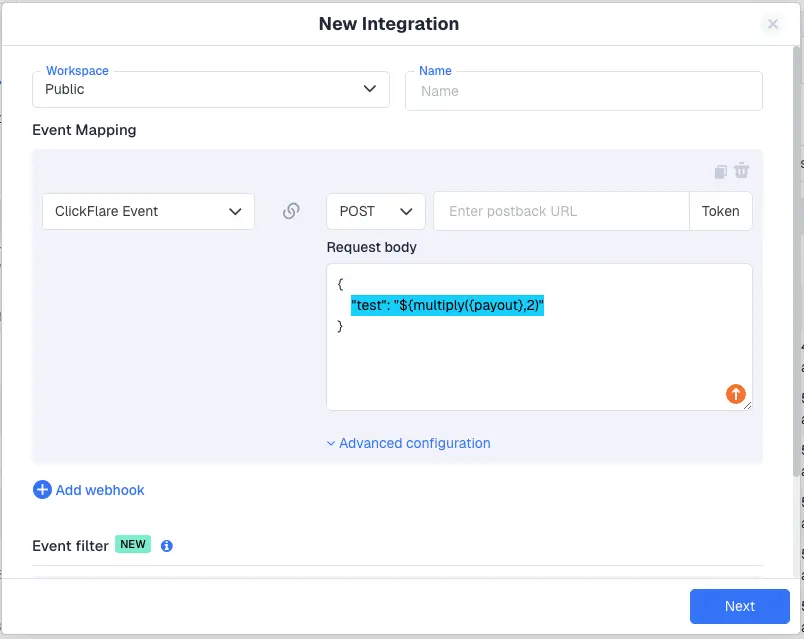
Finally, it supports custom webhook integrations, allowing you to send adjusted values to external systems, automation tools, or internal workflows.
Here are some of the most common ways marketers use conversion value adjustment to improve their accuracy and performance:
In revshare setups, you often share the payout and only keep a percentage of it.
For example, if an offer pays $100 but you only keep 60%, you can send $60 instead of $100 to your traffic source.
This ensures that optimization is based on your actual revenue, not the gross payout.In this case, you simply need to add this to your Conversion API, postback, offer or lander URL, or your custom webhook as shown above:
${multiply({payout}, 0.6)}
Some conversions may have unusually high payouts that can distort optimization.
For example, if most conversions are worth around $50 but one conversion is worth $500, sending that full value can cause the algorithm to overestimate performance.
By applying a cap, you can limit the value sent, for example max $100 per conversion, keeping your optimization signals more stable and consistent.
To cap the payout value at $100, you can apply this formula:
${if({payout} > 100, 100, {payout})}
In certain scenarios, payouts can vary based on performance tiers. For example:
This type of logic allows you to control how different conversion levels influence optimization.
The formula in this case would be:
${if({payout} > 100, 40, 20)}
Conversion value tracking is not limited to payout adjustments. In some cases, you may need to clean or standardize values such as campaign names or tracking fields before sending them out.
You can use this logic to format tracking parameters correctly, remove spaces, or apply naming conventions.
This ensures that data passed to integrations, webhooks, or reports remains consistent and usable across your entire setup.
For example, if {trackingField1} contains:
premium_user
But you want to capitalize it:
PREMIUM_USER
You can use this formula:
${upper(trim({trackingField1}))}
If you want to learn more about how this works, we have a full guide about how to apply different logic and formulas to your conversion value tracking setup.
As explained above, there are situations in which it is smarter to send adjusted conversion values rather than raw payouts.
One of the most common situations is revenue share (or revshare) agreements.
For example, an affiliate network might pay you $100 per conversion, but you keep only 60% of that revenue after sharing it with a partner or publisher.
If you send the full $100 value from your tracker, the ad platform’s algorithm will assume that is the real value of this conversion.
This can lead to inflated metrics and inefficient optimization decisions.
Another common challenge is dealing with unusually large payouts.
Some offers may occasionally generate high-value conversions that are far above the average.If you send such large values directly to your ad platform, it may disrupt the optimization process.
For example, a single $500 conversion could cause the algorithm to aggressively scale traffic that does not normally perform well.
Setting a cap on payout values helps keep the optimization signals consistent.
There are also certain agreements where payout depends on performance tiers or bonuses. For example, you might earn:
In these cases, the value sent to the traffic source may need to be adjusted dynamically to reflect the actual payout logic.
Without features like Smart Payout Control, marketers could typically not adjust payout values inside their tracker. They would have to manually adjust these values before sending them to their traffic source. One common way to do this was using external scripts.
These scripts would apply logic such as revenue share or tiered payouts to the postbacks or API calls before they reached the traffic source.
This would require you to manually add scripts, which requires technical knowledge and constant maintenance, especially as your setup becomes more complex. In many cases, marketers adjusted the payouts manually in their network or using spreadsheets.
This approach does not hold up when trying to scale, and it’s prone to errors. These methods added unnecessary complexity into conversion value tracking.
They made setups harder to manage and more prone to mistakes, which ultimately affects reporting accuracy and campaign performance.
We already touched upon some of the benefits of advanced conversion value tracking before, with the main one being more accurate campaign optimization.
Ad platforms are constantly using these signals you send to optimize your targeting, bidding, and campaign scaling.
The more accurate information you send regarding payouts, the better these optimizations will be. This feature also gives you more flexibility to track different campaign structures and business models.
It also simplifies your tracking setup by allowing you to handle value adjustments directly within your tracker, instead of relying on technical workflows or external tools.
To get the most out of the Smart Payout Control feature, you need to follow a few simple guidelines. First, it is recommended to cap extreme payouts.
These outliers can confuse the ad network algorithm and lead to your campaigns being optimized with incorrect information. Second, you can userounding functions if traffic sources require integers.
Some ad networks do not accept decimal values, so rounding your conversion values prevents errors in both reporting and optimization.
When using Maximize value of conversions as an objective, some of our users have reported success by posting back a lower payout value than the actual one.
When maximizing for value, platforms like Meta may bid more aggressively to reach users that are worth more. This often leads to higher CPA and increases the overall cost of traffic.
This is especially common in the lead generation vertical, where most marketers are optimizing for lead quality. This also makes sense if you want to optimize based on profit figures, not just revenue. For example, a lead may be worth $80, but you incurred a cost of $20.
You can send only the difference of $60 as payout value to the traffic source for more accurate optimization. On the other hand, some media buyers are using the opposite strategy by sending slightly higher values to the ad platform in order to push the algorithm toward higher-quality leads.
By doing this, you are essentially telling platforms like Meta or TikTok which events to prioritize, reaching higher intent users. This strategy is more risky than the previous one, and you need to ensure to only increase payouts by a small percentage and keep monitoring CPA in case it shoots up.
Third, keep your formula logic simple and readable. Do not overcomplicate the formulas, because that makes them more prone to errors and difficult to manage over time.
Finally, it’s very important to test formulas before going live.
Small mistakes in the formula syntax or logic can lead to incorrect values being sent out, so make sure everything is working properly.
Conversion value tracking has become a crucial part of how ad platforms optimize campaigns. As algorithms increasingly rely on value signals to make bidding and targeting decisions, the accuracy of the values you send plays a direct role in campaign performance.
Raw payout values are often not enough. Whether you are dealing with revshare agreements, payout caps, tiered commissions, or custom logic, being able to adjust values before they are sent is very important.
By controlling conversion values directly inside your tracker, you can send more accurate data to ad platforms, simplify your setup, and reduce the risk of human errors.
This leads to more reliable optimization, better scaling decisions, and stronger campaign performance.